






- 120 Views
- 6 Min Read
- (0) Comment
The 1,200 ending work in course of items are one hundred pc full with regard to material and have 1,200 (1,200 × 100%) equal units for material. The 1,200 ending work in course of models are only 35% full with regard to conversion prices and symbolize 420 (1,200 × 35%) equivalent units. In CPA Canada’s CFE, Core 2 and PM exams, you probably can count on to see complicated management accounting (MA) topics tested. Understanding tips on how to calculate equal models is a fundamental how to calculate the started and completed units concept, significantly in the context of course of costing. This is commonly examined, notably for the Core 2 multiple-choice questions (MCQs). Figuring Out equal units are necessary in determining whole units of manufacturing, however it additionally influences cost allocation decisions in manufacturing processes.
The equal units of production for conversion prices equals the number of entire items times the proportion of conversion that takes place in May. This report reveals the costs used within the preparation of a product, including the fee per unit for materials and conversion prices, and the amount of labor in process and completed items inventory. A full manufacturing price report for the shaping division is illustrated in Determine 5.6 below. A complete manufacturing value report for the shaping department is illustrated in Determine 8.seventy one. Direct materials is added in levels, similar to the start, middle, or end of the method, while conversion costs are expensed evenly over the process.
I Wish To Be A Lawyer: A Step-by-step Guide To Becoming An Legal Professional

This stock is continually changing as materials are added, labor is applied, and manufacturing processes are completed. For total equivalent items, this is the sum of the items transferred out, together with your ending inventory. In this methodology, both the beginning and ending stock is converted into equivalent units, so there is slightly more work to do.
- First, we have to know our whole prices for the interval (or total costs to account for) by adding beginning work in course of prices to the prices incurred or added this era.
- On the other hand, the Weighted-Average technique blends all the prices collectively to find an average price per unit.
- With Out this, we can’t assign costs to products in several stages of completion, so we won’t know the true prices at interval end.
Accounting For Managers
For instance, if we now have 3 models 1/3 of the best way complete, we are in a position to add them collectively to make 1 equal unit (1/3 + 1/3 + 1/3). We could make this calculation easier by multiplying the models by a proportion of complete. In the present interval, we transferred 500 models to course of 2, and have 350 equal items in our WIP stock. So our equivalent units of manufacturing for the interval could be 850 models.
All of the units transferred to the next division should be 100 percent complete with regard to that department’s value or they would not be transferred. So the number of units transferred is identical for material models and for conversion models. The course of cost system must calculate the equivalent models of manufacturing for units accomplished (with respect to materials https://www.personal-accounting.org/ and conversion) and for ending work in course of with respect to supplies and conversion.
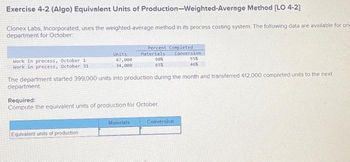
The second step is to classify the models into certainly one of three groups within the equivalent models of manufacturing for materials column based on once they had been started and completed in accordance with the data given. Remember the belief is that supplies are added when a batch is started. Equal items of production for supplies equals the variety of models in each group that had supplies added in May. The May 31 stock in Division B (June’s beginning work in process) consists of two,000 units that are absolutely full as to supplies and 60% complete as to conversion. (b) completed from starting stock, models started and completed through the period, and items partially completed in ending stock.
6: Process Costing (fifo Method)
Equivalent items (EU) is a approach to measure partially completed products as in the event that they were fully accomplished. The reason we do it is as a result of it helps to calculate the costs of merchandise that aren’t yet finished at month-end or year-end. With Out this, we can’t assign costs to products in several levels of completion, so we won’t know the true costs at interval end. Whereas process costing tracks prices for huge number of similar merchandise, job costing tracks prices for specific, particular person jobs or orders, which are sometimes distinctive. For example, constructing a custom piece of furnishings or a unique development project would use job costing.
However after the rain stopped, you can empty two of the buckets by filling the other six. One factor to maintain in mind when utilizing the weighted average methodology, we don’t need to compute the equivalent units for the ones transferred out. Those are thought of 100 percent complete for the work accomplished in that department, in any other case they wouldn’t be transferring ahead to the subsequent process. These prices are then used to calculate the equal models and complete manufacturing prices in a four-step course of. (12) Complete equivalent models of manufacturing for conversion prices equals the sum of the three teams.
So, if the factory had totally different prices for chocolate bars at different occasions, the Weighted-Average technique would add up all the prices and divide by the whole variety of bars produced to get a single average value per bar. This makes it easier to calculate costs when there are lots of different prices over a interval. First, we want to know our total prices for the interval (or total costs to account for) by adding beginning work in course of prices to the prices incurred or added this period. Then, we examine the total to the fee assignment in step four for units accomplished and transferred and ending work in course of to get complete items accounted for. First, we have to know our complete prices for the interval (or complete costs to account for) by adding beginning work in process prices to the prices incurred or added this era. Accountants usually assume that models are at the similar stage of completion for each labor and overhead.
For items in ending work in course of, we’d take the units unfinished x a percent full. The p.c full can be completely different for direct materials, direct labor or overhead. For the shaping division, the materials are one hundred pc complete with regard to supplies costs and 35% full with regard to conversion prices. The 7,500 models accomplished and transferred out to the ending department have to be one hundred pc complete with regard to supplies and conversion, so they make up 7,500 (7,500 × 100%) units.



Leave a comment: